
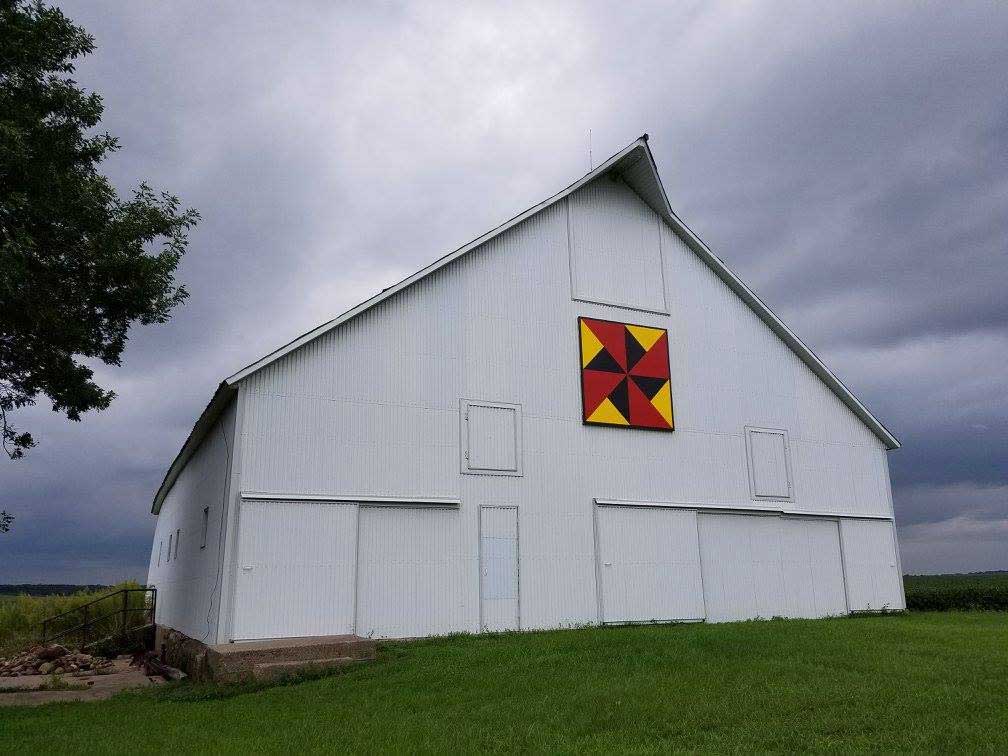
The Sac County barn quilts started in 2005, and a half-day loop past them is one of the better ways to spend an afternoon here. They are eight-foot quilt blocks painted in bright primary colors and mounted high on barns and corn cribs, almost all on hard-surface roads, set five to ten miles apart along a route that runs through nearly every town. A roadside sign at each one tells you the pattern’s name. The maps are free, sitting on the counter at convenience stores, museums and city offices around the county, and a PDF of the route waits at barnquilts.com. You can run the whole loop in a half day, or take one stretch and do it in about two hours.
Key takeaways
- The project began in 2005 as a 4-H effort by a Sac City student, Kevin Peyton, and it grew from there.
- Maps are free at convenience stores, museums and city offices in the county, or as a PDF from barnquilts.com.
- The printed map covers the original 55 barn quilts and 19 community quilts. Plenty more have gone up since, and none of those are on any map.
- A half day gets the full route. Two hours gets a good chunk of it.
- October is the month for it, when the color is up and the combines are running.
Most people find the barn quilts by accident. You come off four-lane U.S. Highway 20 heading somewhere else, a bright block on the peak of a barn catches your eye, and then a few miles on you see another. At that point you either keep going, or you go looking for the rest. This post is for the people who go looking.
What are the Sac County barn quilts?
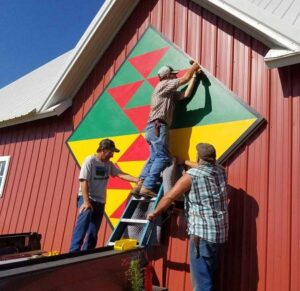
A barn quilt is a quilt pattern painted on wood and hung high on a barn or corn crib. The county’s are eight feet square, painted in bright colors chosen to read from a moving car. The quilters picked designs with straight lines and names tied to farming, so you will pass blocks called Pig’s Tail and Double Windmill as you drive through.
The committee set rules about where a quilt could go. The building had to be a barn or corn crib, at least 50 years old, on a hard-surface road, visible from both directions, and on a working farm. That last one matters more than it sounds. You are not driving past decorations. You are driving past farms people still run, and the block says something about the family behind it.
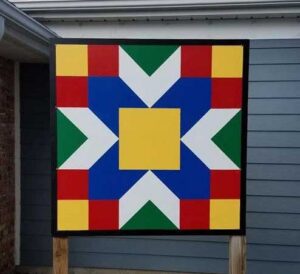
There is a second, smaller layer. Community quilts, about four feet square, sit near museums, libraries and parks in the towns. They were added to pull travelers off the county road and into town, and they do the job.
Where do you get a barn quilt map?
Three ways, and none of them cost a thing.
- Pick up a printed map here. They are stocked at convenience stores, museums, city offices, campgrounds and motels around Sac County. If you are already in the county, this is the easy answer.
- Download the route map as a PDF from the Barn Quilts of Sac County route map and print it before you go. There is a Google map on the same site if you would rather navigate from your phone.
Brochures also turn up in Iowa Welcome Centers across the state. Two honest notes before you lean on any of it. The printed map goes back to 2006 and shows the 55 barn quilts and 19 community quilts that existed then. Families, businesses and homeowners have put up plenty of their own since, and not one of those is on the map. You will find quilts the map does not know about. That is half the fun. And barnquilts.com is a volunteer site that has not been updated in a few years. The maps and the history on it are good. Treat the rest as a snapshot.
How long does the drive take?
Here is how I would plan it. Give yourself a half day, three to four hours, to run the full route and stop in a couple of towns. If you have two hours, start in Sac City and work east or south on the numbered roads, and you will still pass a couple dozen blocks. They sit five to ten miles apart, so a rhythm sets in: drive, spot the sign, slow down, look up. Cell service is thin in spots, so put the paper map on the passenger seat.
One request, from the families who host these. The quilts are on private property. Photograph them from the road, and if you want a closer look, ask first. Most people here will say yes, and then tell you about the barn.
How did one county end up with this many?
It started in 2005 with a Sac City student, Kevin Peyton, who was looking for a project for his 4-H work and the Herbert Hoover Uncommon Student program. He had heard about the barn quilts in Grundy County, the first county in Iowa to paint them, and decided Sac County should be next.
The part worth telling is what he did first. He did not start painting. He built a PowerPoint and went around asking for help, and the first presentation was to the Sac County Rural Electric Cooperative, because a quilt goes up on the peak of a barn and almost no farmer owns a boom truck. The REC said yes. Without that, the project stops at the idea stage, and I have seen plenty of good ideas stop exactly there.
From there it spread the way things do in a county like this. A local quilters group picked the patterns and marked them on the wood, the Extension office helped form a committee, and Farm Bureau, the Arts Council, the Historical Society, the 4-H clubs and the Iowa Barn Foundation each took a piece of it. Kids and retirees did the painting, some as young as eight or nine. There were 23 barn quilts by the end of that first summer, 55 by 2006, plus the 19 community quilts, and more than 1,200 volunteers had a hand in it.
The quilts are old enough now to need repainting. Rather than pull the originals down, the committee paints the same pattern on new sign board and mounts it over the old plywood. That tells you how people here feel about them.
What else is worth stopping for?
The route runs through the towns on purpose, so build a few stops into it.
- Sac City. The county seat, with turn-of-the-century architecture, the historic Chautauqua Pavilion, the Sac County Freedom Rock and the World’s Largest Popcorn Ball in its own shed at the Museum Village.
- Lake View. Black Hawk Lake sits on the edge of town, and the stone piers are a good place to eat lunch out of the car. Our Black Hawk Lake guide covers the rest.
- Wall Lake. Andy Williams was born here, and his childhood home opens on summer weekends or by appointment.
- Auburn. Grant Park, which the county has long described as home to every tree native to Iowa. We treat that as local lore, not a verified claim, but the park is worth the stop regardless.
- The museums. Six towns have one: Auburn, Lytton, Lake View, Wall Lake, Odebolt and Sac City. Most keep seasonal or by-appointment hours, so call ahead in the fall.
For lunch, the places to eat in Sac County are listed by town. Small-town hours move around, and a phone call beats an assumption.
When is the best time to drive the trail?
October, and it is not close. The blocks were painted to stand out against a red barn and a green field, and they look better still with the tree line turning behind them. Peak color here usually lands in October, and the Iowa DNR fall color report tracks it week by week.
Harvest is the other reason. Drive these roads in October and you are sharing them with combines and grain carts, which is the county at work. Give the equipment room and pull over where it is safe to. A farmer on a field road in October has somewhere to be.
Spring and summer work fine too. Winter is bare but honest, and the quilts are up all year and the roads stay open. My pick is a crisp October morning. The harvest has run through, the roads go quiet, and the color is at its peak. That is the one I would take.
Plan your drive
Here is a simple order. Start in Sac City. The Popcorn Ball and the Freedom Rock are in the same stop, and from there work east and south on the numbered roads. Give yourself longer than you think you need. To build a full day around it, our guide to things to do in Sac County lays out what else is within a short drive, and the nine communities each have their own character.
Questions we get
How many barn quilts are in Sac County?
The 2006 printed map shows 55 barn quilts and 19 community quilts. Many more have gone up since, on farms, homes and businesses, and those are on no map. Nobody has an exact current count, which is part of why people keep driving the roads.
Is there a fee to see the barn quilts?
No. The quilts are visible from public roads, the maps are free, and there is nothing to buy or book. Fuel and lunch are the whole cost of the day.
Where can I see barn quilts if I only have an hour?
Start in Sac City and work east or south on the numbered roads. You will pass several barn quilts plus the community quilts in town, and the Popcorn Ball and Freedom Rock are in the same stop.
Can I get a barn quilt for my own barn?
You can. The committee will send a supply list and instructions for building the frame and mounting the block. Reach them through barnquilts.com, and a donation toward the project is appreciated.
If you drive it and find a quilt we should know about, tell us. Check the events calendar before you come so the drive lines up with something else, or get in touch if you are bringing a group and want help with the route.