

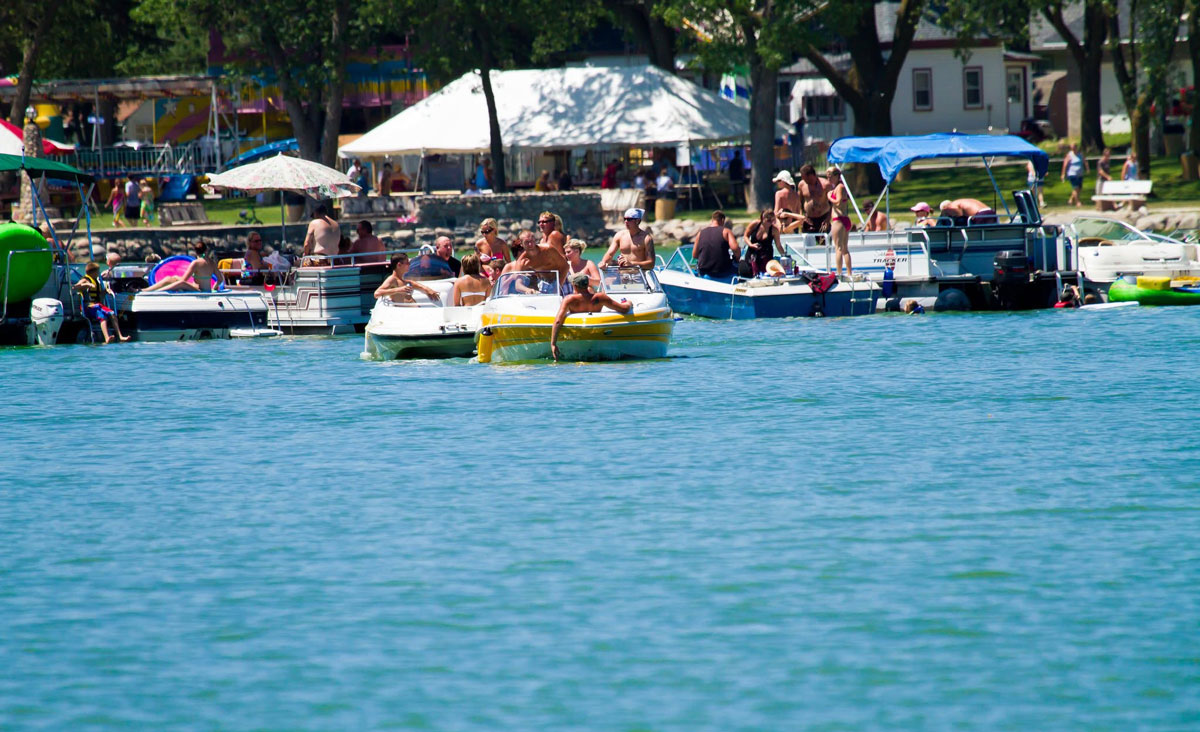
Sac County, Iowa sits in the northwest quadrant of the state, where four-lane U.S. Highway 20 crosses U.S. Highway 71. The short version: the day starts at Black Hawk Lake and ends somewhere you did not plan on. The lake at Lake View covers 957 acres and is the southernmost natural glacial lake in the United States, with boat ramps, two swimming beaches, camping, a universally accessible fishing pier, and free concerts on the stone pier in summer. Sac City has the World’s Largest Popcorn Ball, a Main Street of turn-of-the-century architecture, and the Sac County Freedom Rock. In between run 33 miles of the Sauk Rail Trail, two county parks on the North Raccoon River, museums in six of the nine towns, and more than 150 painted barn quilts on buildings across the county.
Most of it costs nothing, and all of it sits within a few minutes of the highway.
Key takeaways
- Black Hawk Lake at Lake View is the anchor: 957 acres, no motor size restrictions, four boat ramps, two beaches, two campgrounds.
- The World’s Largest Popcorn Ball in Sac City is free to see, any hour, year round.
- The barn quilt tour is a mapped driving route through nearly every town in the county, and the map is free.
- The Sauk Rail Trail runs 33 hard-surface miles south from the lake toward Carroll County.
- Six of the nine towns have museums, most on summer or by-appointment hours.
What is there to do at Black Hawk Lake?
Start here. The lake sits right on the edge of Lake View, and it carries no motor size restrictions, which is unusual for water this size and the reason it pulls boats from well outside the county. Four ramps get you on it. Anglers work channel catfish, crappies, walleyes, bluegills, sunfish, and largemouth bass, and roughly half the shoreline is open to the public, so a boat is optional. There is a universally accessible fishing pier on the north side and a cleaning station near the ramp.
Swim at Thirty Acres or at Crescent Beach. Both campgrounds, Thirty Acres and Camp Crescent, have electric and non-electric sites with modern restrooms and showers, and the Iowa DNR keeps the current reservation details.
The park is older than it looks. Those stone shelters you picnic under were built by the Civilian Conservation Corps in the 1930s, and three sections of the park went on the National Register of Historic Places in 1990. Walkers should take the Stubb Severson Nature Trail, 1.6 miles past twenty marked stops, where deer and waterfowl turn up often enough that you should expect them.
Then there is the Stone Pier Summer Concert Series, four free shows out over the water, which we covered in full in our complete guide to the lake along with where to park on a concert night.
Where is the World’s Largest Popcorn Ball?
Sac City, at the Museum Village near 13th and Main. It has its own shed, and you can look at it through the windows free, any hour, in any weather. Volunteers built the current one in June 2016 at the Noble Popcorn plant, packing it around a cradle form made by Lundell Plastics a few miles away, then forklifted the finished thing across town. It weighs about 9,370 pounds and stands over eight feet tall.
Now, the part that trips people up. Three towns in this county claim popcorn, and they do not agree with each other.
Schaller is called the Popcorn Capital of the World, on the strength of the Bango and Jolly Time packing operations that ran there through the middle of the last century. Odebolt got called the Popcorn Center of the World in a 1914 county history, and the Odebolt Community Center still keeps an exhibit on the town’s popcorn heritage and its link to the Cracker Jack company. Sac City claims the title too, and Sac City has the ball. All three come out of the same real thing, which is that this ground grew a great deal of popcorn for a very long time. We are not going to settle it for you.
The whole story, including Shirley Phillips, the county economic development director whose idea started the popcorn ball and who kept it alive for decades, is in our post on the ball. Sac City itself has a good list of what else is worth stopping for downtown.

What are the Sac County barn quilts?
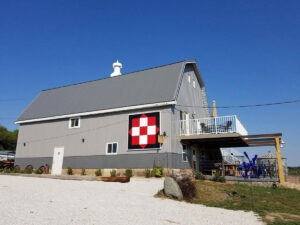
Eight-foot-square painted quilt blocks, mounted on barns, corn cribs, garages, fences, and houses all over the county. Travel Iowa counts more than 150. Most of the host barns are at least fifty years old and almost all sit on hard-surface roads, so the drive doubles as a tour of the county’s old farm buildings. There are community quilts in the towns too, set near historic and public sites, if you would rather not be on gravel.
This started with a kid.
In 2005, Kevin Peyton of Sac City needed a 4-H leadership project and something to put toward a Herbert Hoover Uncommon Student Award. A group of Sac City area quilters picked the patterns for him, choosing names that carried an agricultural meaning. Then school students, 4-H members, and volunteers of every age painted them. By 2006 there were 55 blocks up and the first maps came off the press. Peyton left for college. His parents kept the thing running, the blocks kept multiplying, and county programs elsewhere in Iowa and in other states eventually borrowed the Sac County committee’s instructions to start trails of their own.
Credit where it is owed: the movement began in Adams County, Ohio, when Donna Sue Groves painted a block on her tobacco barn for her mother, a master quilter. Sac County saw it and ran further with it than anyone else in the state.
The committee mapped a tour route touching nearly every town, and the map flags other stops worth pulling over for. Free paper copies sit in convenience stores, museums, and city offices around the county, brochures turn up in state Welcome Centers, and you can pull the route map from barnquilts.com before you leave home.
If you come back a second time, do this instead of the lake. And come in late September rather than July. The light is lower, the corn is still standing, and the gravel is yours.
What else is there to do outdoors?
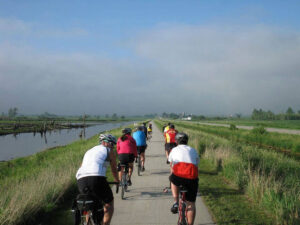
The Sauk Rail Trail is the big one: 33 miles of hard surface following an old rail line from Black Hawk Lake south toward Swan Lake in Carroll County. Ride a mile out and back or commit to the whole thing. Once snow falls it turns into a snowmobile route.
Two county parks are worth building a day around, both on the North Raccoon River, both run by the Sac County Conservation Board, which manages roughly 907 acres across the county.
Hagge Park is 86 acres of oak and hickory woods between Sac City and Lake View, and it doubles as the Conservation Board’s headquarters. Thirteen shaded campsites with full hookups, a shelterhouse with a fireplace, a seasonal cabin, sand volleyball, and a rock riffle in the river for fishing and canoe access. One thing to know before you drive out: the campsites are first-come, first-served with no reservations. It is also where people go to cross-country ski once winter sets in.
Grant Park sits a mile and a half north of Auburn, 98 wooded acres on the same river with three camping areas. Area 1 has 25 full-hookup sites plus restrooms, showers, a playground, and horseshoe pits, and the camping season runs May 1 through mid-October. The fishing riffle there gives up walleye, channel catfish, and carp. The county has long promoted Grant Park as home to every tree native to Iowa, which is a claim we will let the county make. The woods are worth the walk regardless.
Past that: canoeing and kayaking the North Raccoon, disc golf, tennis and pickleball, and hunting for pheasant, geese, ducks, turkey, and deer in season. We break those out on the fish and hunt, trails, parks and camping, and winter activities pages.
February does not shut the county down, either. Lake View runs the Arctic Open, a golf tournament played on a course laid out across the frozen lake.
What is worth seeing in the nine towns?
Sac City is thecounty seat and the oldest of them, founded in 1855. It is a designated Main Street Iowa community, which shows: Victorian homes, a historic courthouse, a business district with specialty shops and antique stores, the Sac County Freedom Rock, and the Chautauqua Pavilion, one of very few still standing anywhere in the country. If you only have time for one town, this is it.
Lake View is the other one people actually plan around. It is the lake town, and in July it is the busiest place in the county by a wide margin.
The rest reward a slower day. Wall Lake is where Andy Williams was born, and the house at 102 E. 1st Street opens weekends in summer or by appointment. Odebolt, just over a thousand people, runs three historical museums on the same kind of schedule. Auburn is your stop for Grant Park, a mile and a half up the road. Schaller carries the popcorn history and throws its own summer celebration. Early hosts one of the Ridge View district’s shared school buildings. Lytton sits on the eastern edge along old Highway 20. And Nemaha, smallest of the nine, holds down the crossroads of county roads M50 and D15, about halfway between Sioux City and Fort Dodge.
Six of the nine have museums: Auburn, Lytton, Lake View, Wall Lake, Odebolt, and Sac City. Nearly all keep summer hours or open by appointment. Call before you drive, because a locked door in Odebolt is a long way to come for nothing. Our communities page has each town, and both sites to see and arts and culture go deeper on the museums.
What annual events happen here?
Every town runs its own, and those are the best days of the year to be here.
The Lake View Water Carnival takes over Black Hawk Lake in July with a street parade, a water parade, rides, and free entertainment. Schaller Popcorn Days brings a carnival, live music, and free popcorn. Then there are Sac City Chautauqua Days, Early Crossroads Days, Lytton Gala Days, and the Wall Lake Farm Festival.
Dates shift year to year, so look at our events calendar or the annual and featured events page before you build a weekend around one.
When is the best time to come?
July is peak. The lake is warm, the concert series is running, the town celebrations stack up on top of each other. It is also the only stretch of the year when this county feels crowded.
Come in late August or September instead. The water holds its heat, the campgrounds empty out, the trail rides better without the humidity, and the barn quilt route is at its best against standing corn. That is the window if you want the lake mostly to yourself.
October closes camping and opens hunting. Winter here is real winter, and the county leans into it: snowmobiling the Sauk Rail Trail, skiing at Hagge Park, ice fishing, the Arctic Open out on the ice. Spring is the thinnest season, worth knowing if museums are your reason for coming, because most of them stay shut until summer.
Where do you eat and where do you stay?
Sac City’s downtown carries the widest run of restaurants in the county, and Lake View feeds the lake crowd all summer. Our eat and drink guide has the current list. Hours in small towns are shorter than you are used to, so check before you count on dinner somewhere.
Lodging is where we should be straight with you. This is a rural county and there is no large hotel selection. In warm weather the real answer is camping, and there are three good options: Black Hawk State Park if you want the lake, Hagge Park for woods and river, Grant Park for the same with more room for a family. Hagge takes no reservations, so arrive early on a summer weekend. Lake View has rooms in town and there are further options scattered around the county, all on our places to stay page. Book well ahead for a Water Carnival or concert weekend. Those fill.
How do you plan a day in Sac County?
Half a day. Sac City. The popcorn ball, the Museum Village beside it, the Freedom Rock, and a walk down Main Street. Straight off Highway 20, costs almost nothing, and works as a break in a longer drive.
A full day. The lake. Swim or fish in the morning, ride a stretch of the Sauk Rail Trail after lunch, eat in Lake View, and if there is a concert on the pier, stay for it.
A weekend. Camp at Black Hawk State Park, then give the second day to the towns and the country roads: Wall Lake for the Andy Williams house, Auburn and Grant Park, Odebolt for the museums, and the barn quilt route stitching them together. Download the map before you leave, because cell service on the gravel is uneven. Our history page is a decent primer for the drive.
Common questions
Is Black Hawk Lake worth the drive?
If you want a full day on open water without queuing for a ramp, yes. It is 957 acres with no motor size restrictions and about half the shoreline open to the public. It is meaningfully less crowded than the bigger lake destinations north of here, and a good deal cheaper for a day out.
Can you see the World’s Largest Popcorn Ball for free?
Yes, any hour. It sits in its own shed at the Sac City Museum Village, visible through the windows around the clock, no charge. The Museum Village next door keeps seasonal hours and also opens by appointment, so call ahead if you want inside the buildings.
How long does the barn quilt tour take?
As long as you want it to. The full mapped loop runs through nearly every town and makes a comfortable half day with stops, but a single leg is about an hour.
What is there to do in Sac County with kids?
The beaches at Thirty Acres and Crescent Beach, the playgrounds and sand volleyball at Black Hawk State Park, the popcorn ball, the Stubb Severson Nature Trail, and the playground and horseshoe pits at Grant Park. The Water Carnival in July is built around kids.
Is there anything to do here in winter?
More than people expect. The Sauk Rail Trail becomes a snowmobile route, Hagge Park draws cross-country skiers, ice fishing runs on Black Hawk Lake, and Lake View plays the Arctic Open out on the frozen lake in February.
How do you get to Sac County?
Four-lane U.S. Highway 20 runs straight across the county and meets U.S. Highway 71 near Sac City. That makes this an easy day trip from Sioux City, Fort Dodge, Carroll, and Storm Lake, and a straightforward drive from the Omaha metro.
Start with the lake
First time here, go to Black Hawk Lake and give it a whole day. Everything else on this page keeps. There is enough for a second trip and a third. Check the events calendar to time it, or get in touch and we will tell you what is worth your time that particular week.